Seventh Terrace
The Seventh Terrace is the highest and final cornice of Mount Purgatory, the place where the sin of lust—the last of the seven deadly sins to be purged—is burned away by a wall of flame. It marks the ultimate threshold of the penitential journey, the point after which the soul, fully cleansed, may ascend to the Earthly Paradise and, eventually, to Heaven. For Dante the pilgrim, crossing this terrace is the most harrowing ordeal of the entire mountain, a trial that tests not only his physical courage but the depth of his desire for Beatrice and for God.
Location and Physical Description
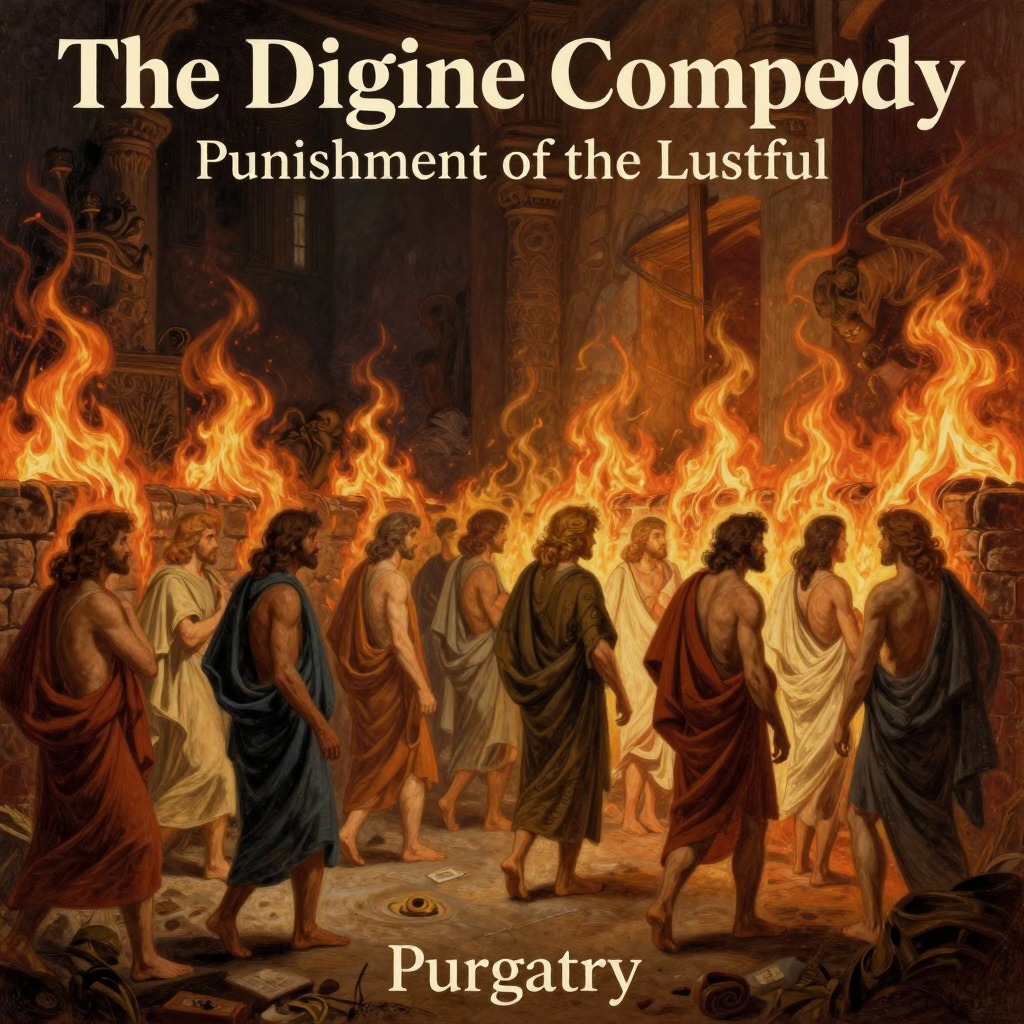
The Seventh Terrace is situated at the very top of the purgatorial mountain, just below the Earthly Paradise. Unlike the lower terraces, which are open to the sky, this cornice is defined by a wall of fire that shoots forth from the embankment and a contrary wind that drives the flames back, preventing them from spreading outward. The path itself is narrow, forcing the penitents—and Dante—to walk single file along the open side, with the fire on one side and a sheer drop on the other. The heat is so intense that Dante later compares it to molten glass, and the experience is so overwhelming that he initially refuses to enter, standing "motionless and stubborn" until Virgil shames him forward.
The Penitents and Their Punishment
The souls being purified on the Seventh Terrace are those who in life were guilty of lust—the excessive or disordered love of sexual pleasure. They walk within the flames, singing hymns such as "Summae Deus clementiae" and crying out examples of chastity and of punished lust. Among the voices Dante hears are those calling out "Virum non cognosco" (the words of the Virgin Mary) and the story of Diana driving Helice from the wood for yielding to Venus. The penitents move in two opposing files, one group crying "Sodom and Gomorrah!" and the other "Into the cow Pasiphae enters!"—each group reproaching itself for its particular form of the sin. The fire does not consume them but rather burns away the dross of their disordered desire, and they endure it willingly, knowing it is the final purification before freedom.
Dante's Crossing and Virgil's Final Guidance
Dante's passage through the Seventh Terrace is the climactic trial of Purgatory. When the angel of God appears at the edge of the flame and commands the pilgrims to enter, Dante is paralyzed with fear, vividly recalling the human bodies he had once seen burned. Virgil, who has guided him through Hell and up the mountain, must use his most powerful appeal: "Now look thou, Son, 'Twixt Beatrice and thee there is this wall." The mere name of Beatrice—the beloved who awaits him in the Earthly Paradise—breaks Dante's resistance. He enters the fire, and Virgil, walking before him, speaks continually of Beatrice to sustain him. The flames, though agonizing, do not harm him; as Virgil had promised, they cannot even singe a hair. On the far side, a voice sings "Venite, benedicti Patris mei," and the pilgrims ascend the final stairway as the sun sets. It is on this last stair that Virgil, having brought Dante to the limit of his own power, speaks his farewell: "The temporal fire and the eternal, Son, thou hast seen, and to a place art come where of myself no farther I discern. By intellect and art I here have brought thee; take thine own pleasure for thy guide henceforth." With these words, Virgil crowns and mitres Dante over himself, and the poet enters the Earthly Paradise alone.
Thematic Significance
The Seventh Terrace is the place where the last vestige of disordered love—the love that clings to created things rather than to the Creator—is burned away. It is the final purification of the will, the point at which the soul becomes capable of loving rightly and freely. The fire is both a punishment and a gift: it is the pain of letting go of earthly attachments, but it is also the necessary precondition for the joy that follows. Dante's terror and his ultimate submission mirror the soul's struggle to surrender its own desires to the divine will. The terrace thus embodies the central paradox of Purgatory: that the most intense suffering is the very means by which the soul is made ready for the most perfect happiness. It is the last step before the Earthly Paradise, the place where the pilgrim, having been stripped of all sin, is finally prepared to meet Beatrice and, through her, to ascend toward God.